Computer Vision
How serial parts production reduced customer claims by 6x with computer vision
Metalworking - serial parts production
TLDR
The plant produces serial metal parts: stamping and turning. Quality control inspected parts visually and selectively with gauges. With a 3% defect rate out of 17,600 parts per month, 211 defective parts reached customers every month as claims; each claim cost about $26-32. BackendFlow installed a CV system: every part passes through an automatic inspection zone.
Result: customer claims decreased by 6x. Forecast reduction in losses is around $5.6K per month.
Context
The line produced 800 parts per shift. Quality control relied on visual inspection and selective gauge checks. It is qualified work, but physically checking every part in the flow is impossible.
With a production defect rate of 3% - normal for serial stamping - about 530 of 17,600 parts per month were defective. Quality control caught 60% before shipment. The remaining 211 reached customers.
For production: the cost of one claim - return, repeat delivery, rework, and administrative labor - averaged 3-5x the part cost. With an $8 part, a claim costs about $26-32. 211 claims per month equals about $6.5K in direct losses.
For customers: defects were discovered during assembly or operation, after the part had already been installed in a product.
Task
Detect defective parts before shipment automatically, without depending on the inspector's attention and fatigue. Quality control remains in the process: the inspector handles borderline cases and maintains the nonconformity register.
Solution
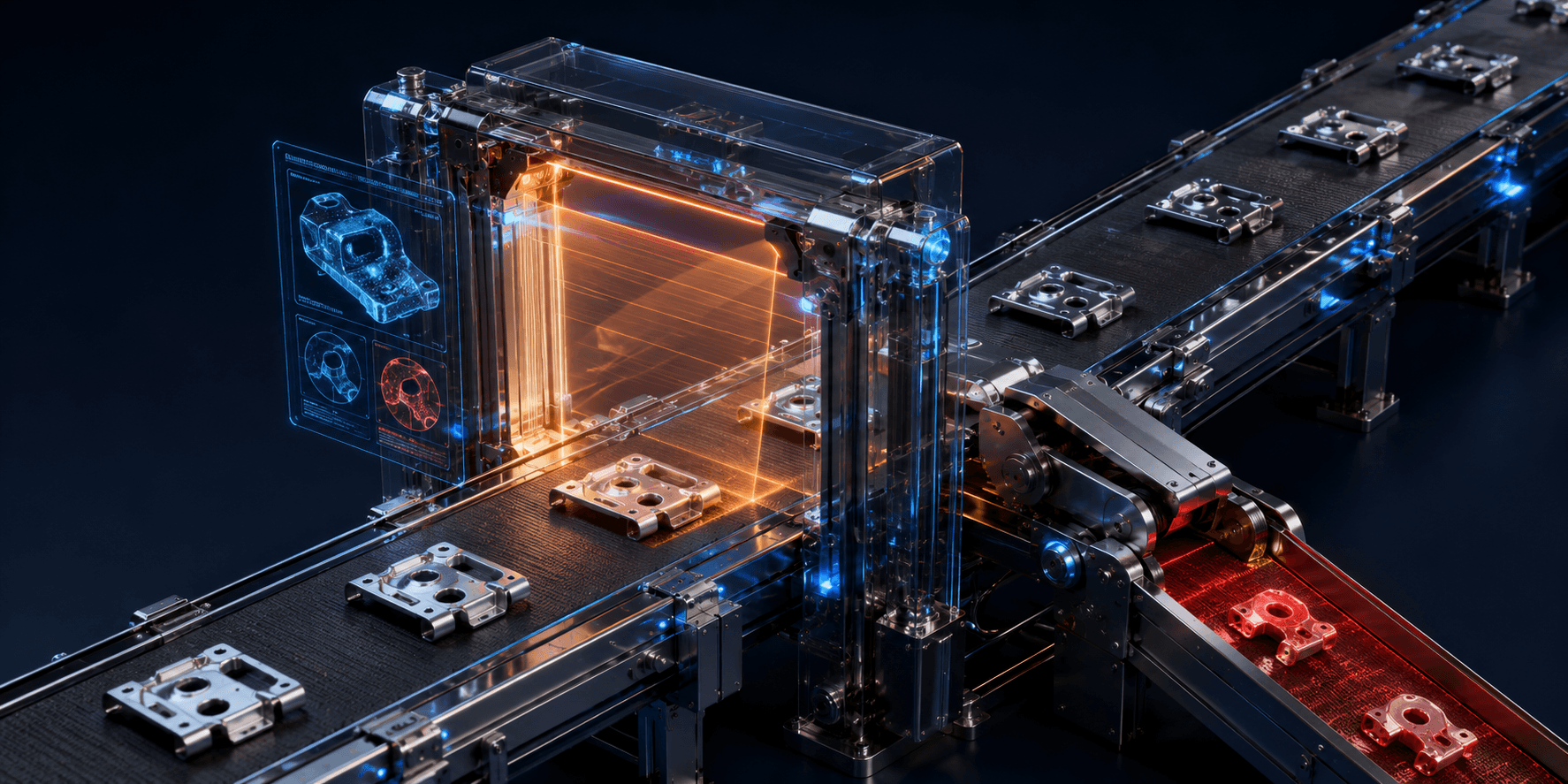
BackendFlow installed a CV system with industrial cameras at two conveyor points.
The key equipment point: defectoscopy of metal parts at conveyor speed requires global shutter cameras; they capture moving objects without blur. Specialized lighting is also required for the surface type: the angle and nature of illumination are critical for detecting scratches and dents. Standard video surveillance cameras do not provide the required accuracy here.
Workflow:
- The part moves through the inspection zone on the conveyor
- Cameras capture images from both sides
- The system analyzes geometry and surface in real time
- A defective part triggers automatic rejection and an operator signal
- A clean part continues to packaging
During the first 4-6 weeks, the model was fine-tuned on real defects from this exact production line. Universal metal models provide 80-85%; fine-tuning for a specific part range reached 93-95%.
Insights
Fine-tuning for a specific production site is not optional; it is necessary.
Early attempts to implement CV in manufacturing often disappoint: a universal model is used and gives 80-85% accuracy. At that level, false positives create more problems than the system solves. What works is fine-tuning for the specific defect nomenclature of the plant.
Quality control was not eliminated - its role changed.
The inspector stopped being the main defect detector and became an analyst: handling borderline cases, maintaining the nonconformity register, and analyzing root causes. This is more qualified work that used to be crowded out by flow inspection.
The system data exposed an upstream process problem.
The first month of the nonconformity register showed that 40% of defects of one type were concentrated in a specific shift. That became the starting point for process-level analysis, not just quality control.
Results
| Metric | Before | After |
|---|---|---|
| Defective parts reaching customers | ~211 pcs/month | ~32 pcs/month |
| Defect detection accuracy | ~60% (QC) | 93-95% (CV) |
| Direct claim losses | ~$6.5K/month | ~$900/month |
Assumptions: 17,600 parts/month, 3% defects, part cost about $8, claim = 4x part cost. Target performance from the 2nd month after fine-tuning is complete. Verification after a quarter.
Want the same kind of calculation for your production?
Book an audit ->